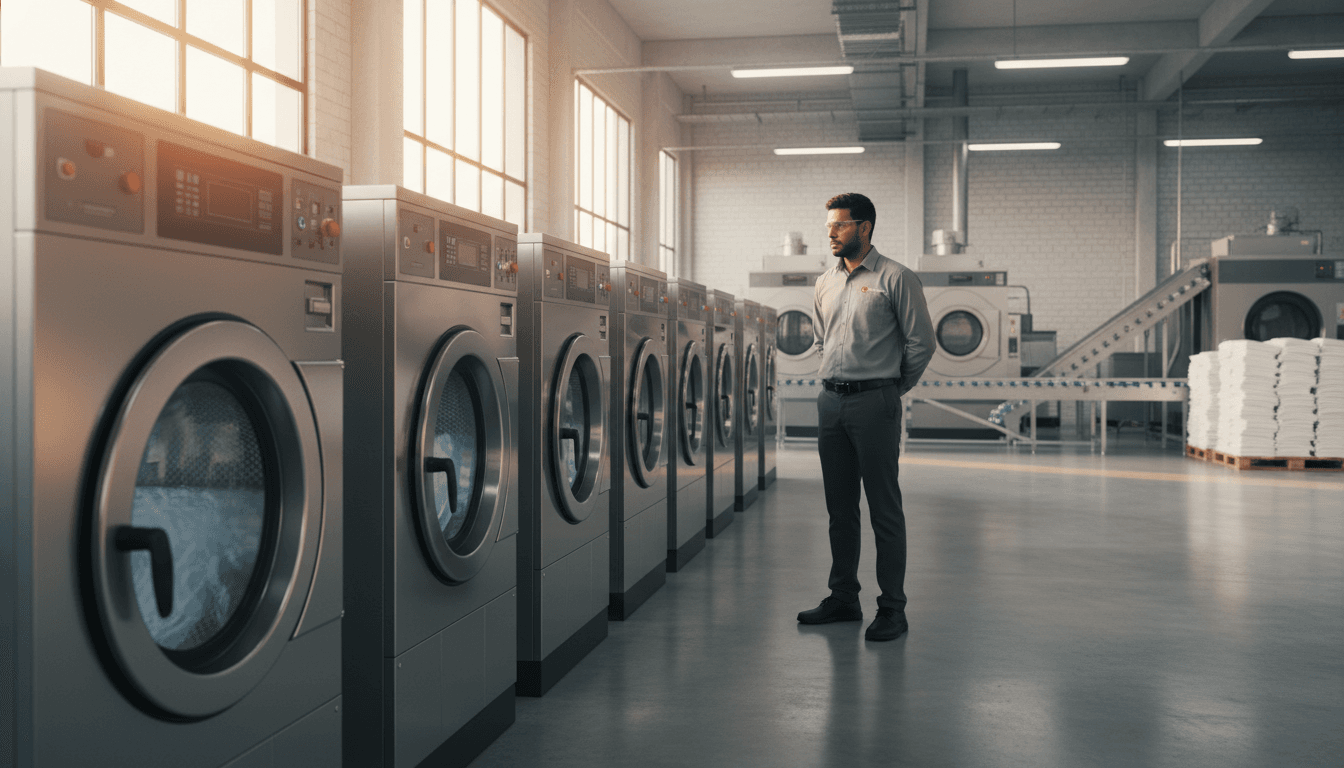
Industrial Washing Machine Installation: The Foundation of Operational Excellence
The performance and longevity of an industrial washing machine are determined long before the first load of laundry is processed. While the quality of the machine itself is paramount, the professional installation of that equipment is the true foundation of operational uptime. A poorly installed machine will suffer from excessive vibration, utility leaks, and premature component failure, leading to costly repairs and disrupted laundry cycles.
Sunshine Equipment specializes in high-precision industrial washing machine installation across India. We believe that installation is not merely about moving a machine into a room; it is an engineering project that requires careful site auditing, utility planning, and technical execution. Whether you are setting up a small commercial laundry or a massive centralized hospital plant, our protocols ensure that your equipment is optimized for peak productivity and maximum safety.
In the Indian context, installers must navigate specific challenges such as fluctuating power quality, varying water hardness, and environmental heat. Our team address these issues by implementing robust protection systems-ranging from voltage stabilizers and water softeners to advanced drainage designs. We work closely with your facility engineers and architects to ensure that the laundry room is designed for a seamless workflow, minimizing labor movements and maximizing hygiene standards.
This guide provides a comprehensive breakdown of the technical requirements for a world-class industrial laundry installation. From the depth of the concrete foundation to the diameter of the drainage lines, we explore every detail that contributes to a successful project. By following these professional standards, you protect your capital investment and ensure that your laundry operations rank at the top of the industry in terms of efficiency and reliability.
Strategic Site Selection and Spatial Planning
Choosing the right location for your industrial washing machine is the first step in successful installation. The room must be large enough to accommodate the physical dimensions of the machines while leaving ample space for operational access, maintenance work, and the movement of laundry carts. We recommend a spatial planning model that allows for 1.5 to 2 times the machine's footprint for a safe and productive environment.
Vertical space is often overlooked but is equally critical. A ceiling height of at least 3.5 to 4 meters is ideal to accommodate the installation of overhead utility lines, steam pipes, and ventilation ducting. This height also ensures better air circulation, preventing the buildup of humidity and heat that can damage electronic controllers and create discomfort for staff. Proper lighting and non-slip industrial flooring are other essential components of the site selection phase.
Proximity to main utility lines-water inlets, 3-phase power hubs, and industrial drains-is a major factor in reducing installation costs and maximizing efficiency. Long runs of piping or wiring increase the risk of pressure drops and energy loss. We conduct a detailed site audit to identify the most efficient machine placement, providing you with a "Rough-In Drawing" that guides your plumbers and electricians during the construction or renovation phase.
Accessibility for equipment delivery is another practical consideration. Industrial washers are heavy, single-piece units that cannot be easily disassembled. We evaluate the path from the loading bay to the laundry room, checking the dimensions of doorways, hallways, and elevators. If necessary, we coordinate the use of specialized lifting equipment or temporary structural modifications to move the machines into place without damaging your facility or the equipment.
Structural Engineering: Flooring, Leveling, and Anchoring
The sheer weight and high-speed G-forces of an industrial washing machine require a superior structural foundation. Hardmount washer extractors, which are common in many Indian industrial laundry plants, rely on the floor to absorb the vibration generated during the high-speed extraction cycle. This means that a standard commercial floor is often inadequate; a reinforced concrete slab with a thickness of 6 to 8 inches is the minimum requirement.
Leveling is the most critical part of the physical installation. If a machine is installed at an angle, the internal drum will spin unevenly, putting extreme stress on the bearings, shaft, and motor. This leads to excessive noise and premature mechanical failure. Our installers use precision laser levels to ensure that the machine is within a 2-degree tolerance of perfectly flat. We then use industrial grade shims or adjustable feet to lock the machine into position.
Anchoring the machine to the floor is what prevents "Machine Walk" and structural damage. We use heavy-duty chemical or mechanical expansion bolts that are set deep into the concrete. These anchors must be tightened to specific torque settings provided by the manufacturer. For installations on sub-optimal floors, we can design specialized inertia blocks-thick beds of reinforced concrete that add mass to the foundation and help dampen the vibration before it reaches the rest of the building.
For facilities located on upper floors or where vibration is a concern, we utilize Softmount technology. These machines feature an internal suspension system of springs and shock absorbers. While they do not require a massive foundation, they still need a level and structurally sound floor capable of supporting the static weight of the machine plus the water and laundry load. Proper structural planning is the only way to ensure 100 percent safety during high-volume operations.
Advanced Utility Infrastructure: Electrical Systems and Power Quality
Industrial laundry machines are high-power consumers that require specialized electrical infrastructure. Most equipment in India operates on a 3-phase, 400V or 415V supply. It is vital that each machine has its own dedicated circuit and a correctly sized MCCB (Molded Case Circuit Breaker) in the main distribution panel. This prevents the "Daisy-Chaining" of equipment, which is a major fire hazard and a leading cause of electrical failure in industrial settings.
Power quality in India can be unpredictable, with voltage surges and sags that can damage the sensitive PLCs (Programmable Logic Controllers) and frequency inverters used in modern machines. We strongly recommend the installation of an industrial-grade Servo Voltage Stabilizer or an isolation transformer for the laundry room. This ensures a consistent, clean power feed that protects your electronics and prevents the unexplained sensor errors and program crashes that plague poorly wired facilities.
Grounding and earthing are essential for both machine longevity and operator safety. Every machine must be connected to a high-quality earth pit with a low resistance rating (typically below 1 Ohm). This provides a safe path for fault currents and prevents the buildup of static electricity on the stainless steel casing. Our electrical installation team conducts continuity tests on all earthing connections as part of our standard commissioning process.
Finally, we focus on the professional routing of electrical cabling. We use industrial grade conduits or cable trays to protect the wiring from the heat and humidity of the laundry room. Cables must be sized correctly for the distance and the load to prevent voltage drop and overheating. By engineering your electrical system to these high standards, we ensure that your installation is fully compliant with Indian electrical codes and optimized for long-term reliability.
Water Management: Precision Supply and Industrial Drainage
Water is the primary medium of the wash, and its professional management is key to cycle efficiency. Industrial washing machines require both hot and cold water supplies with high flow rates. The inlet piping must be large enough (typically 1 to 2 inches) to fill the machine quickly. If the flow rate is restricted, the fill phase of the cycle is extended, reducing the number of loads you can process per day and increasing your labor costs.
Water pressure is another critical factor. We recommend a dynamic pressure of 3 to 5 bar for optimal performance. If your facility has low gravity pressure from a rooftop tank, we install booster pump systems with automated pressure switches to ensure the machines always have the power they need. We also install high-quality shut-off valves and flexible, industrial-grade inlet hoses that can withstand the constant opening and closing of the machine's solenoid valves.
Drainage is where many installations fail. An industrial washer extractor can dump 500 liters of water in less than 60 seconds during the drain phase. The drainage system must be able to handle this massive surge without backing up. We design drainage lines with a minimum diameter of 4 inches (100mm) and a steep downward slope. The machine's drain should be an "Open Drain" type-emptying into an floor gutter or a large-diameter pit with an air break to prevent back-flow and contamination.
Water quality in India often involves high levels of hardness or TDS (Total Dissolved Solids), which can lead to scale buildup in the machine's heaters and valves. This scaling reduces heating efficiency and causes premature seal failure. As part of our installation service, we test your water and, if necessary, recommend the installation of an industrial water softener or an RO system. This ensures that the water is gentle on both your machines and your linens, providing a superior wash result every time.
Thermal Systems: Steam and Gas Integration for Rapid Heating
To achieve effective sanitization, especially in healthcare and luxury hospitality, water must be heated rapidly to specific temperatures. While electric heating is common for smaller units, large industrial facilities often utilize steam or gas heating due to their higher thermal power and lower operational costs. The installation of these thermal systems requires specialized knowledge of high-pressure piping and safety regulations.
Steam-heated machines require a reliable supply from an industrial boiler. The steam lines must be insulated to prevent heat loss and ensure the safety of operators. We install precision trap systems and strainers to manage condensate and prevent "Water Hammer"-the destructive shock wave caused by trapped water in steam lines. Our team ensures that the steam pressure at the machine's inlet matches the manufacturer's specification (typically 4 to 6 bar) for the most efficient heating performance.
Gas-heated washer extractors and tumble dryers are an increasingly popular choice in India due to the availability of PNG (Piped Natural Gas). These machines require professionally installed gas lines with integrated safety shut-off valves and leak detection sensors. Proper gas pressure is vital; if the pressure is too low, the burners will not achieve the required BTU output, leading to slow drying times and inconsistent wash temperatures.
Regardless of the heating type, we integrate the thermal system with the machine's electronic controller. This allows for precise temperature modulation, ensuring that the water reaches the set point quickly without overshooting. This precision is vital for protecting delicate fabrics and ensuring that sanitization protocols are met 100 percent of the time. Professional thermal integration is what separates a world-class installation from a standard one.
Environmental Controls: Ventilation and Humidity Management
A busy laundry room is an environment of intense heat and moisture. Without professional ventilation, this humidity can build up, leading to mold growth, fabric contamination, and the premature corrosion of machine components. Proper airflow is also essential for the comfort and productivity of your operators. We design ventilation systems that maintain a constant flow of fresh air while effectively exhausting the hot, damp air generated by dryers and ironers.
Exhaust ducting for tumble dryers is a critical safety component. The ducts must be as short and straight as possible to minimize back-pressure and prevent the buildup of lint. Lint is highly flammable and the leading cause of fires in industrial laundries. We use high-quality, smooth-walled metal ducting (avoiding flexible plastic) to ensure maximum airflow and safety. Every duct system includes easy-access points for regular cleaning and inspection.
"Make-Up Air" is another essential concept. For every cubic meter of air that is exhausted by the dryers, a cubic meter of fresh air must be allowed into the room. If the room is "tight" and lacks makeup air, the dryers will work harder, consume more energy, and experience longer drying times. We install specialized louvers or fresh-air intake fans to ensure the laundry room maintains a neutral or slightly positive pressure, optimizing the performance of every machine.
In larger facilities, we implement "Zonal Ventilation." This focuses the highest airflow on the hot areas-around the ironers and dryers-while maintaining a more moderate environment in the folding and sorting areas. By managing the climate of your laundry room, we protect your equipment from humidity-related electronic failures and create a professional workspace where your staff can perform at their best.
Workflow Optimization: Implementing the Barrier Concept
The layout of the machines determines the efficiency of the entire operation. A professional installation focuses on "Unidirectional Workflow"-ensuring that laundry moves in a straight line from soiled intake to clean output without ever backtracking. This eliminates bottlenecks and significantly reduces the risk of clean laundry being re-contaminated by dirty linen or staff moving between different zones.
In healthcare settings, we implement the Barrier Concept. This involves using specialized "Barrier Washers" which are installed into a physical wall that bisects the laundry room. The soiled laundry is loaded from one side (the "Red Zone"), and once the wash cycle is completed, the clean, sanitized laundry is retrieved from the other side (the "Green Zone"). This physical separation is the gold standard for hospital hygiene and is a requirement for many international accreditations.
We assist in designing the "Logistics Path"-ensuring there is enough floor space for carts to pass each other and that the machines are placed at heights that minimize bending and lifting for operators. This ergonomic approach reduces staff fatigue and workplace injuries, leading to a more stable and productive workforce. Our layout designs include dedicated areas for sorting, weighing, chemical storage, and final packaging.
Every Sunshine installation includes a workflow audit. We observe your team's movements and provide recommendations for optimizing the "touches per kilogram" of laundry. By reducing unnecessary movements and streamlining the path of the fabric, we can help you achieve a 10 percent to 20 percent increase in throughput without adding any additional staff. Optimization is the invisible part of a professional installation that delivers the highest return on investment.
Testing and Commissioning: Ensuring Multi-Point Performance
The final stage of installation is "Commissioning"-a series of rigorous technical tests that prove the machine is ready for full-scale operation. We do not consider an installation complete just because the machine turns on. Our commissioning protocol involves a 50-point checklist where we measure everything from water fill times and heater performance to the exact RPM during high-speed extraction and the functionality of every safety interlock.
We conduct "Wet Tests" where the machine is run with a full load of laundry. During this test, we monitor for any leaks in the pipework, unusual vibrations in the foundation, or imbalances in the electrical phases. We verify the accuracy of the temperature sensors and the chemical dosing points, ensuring that the wash programs are executing exactly as designed. This documentation creates a "Baseline Performance Record" for your facility.
Safety interlock testing is the most vital part of commissioning. We verify that the door locks and sensory guards are functioning 100 percent of the time, preventing any possibility of the machine starting while a door is open or an operator being near moving parts. We also test the "Emergency Stop" buttons and the fire suppression systems in the dryers. A safe installation is the only way to protect your institution from professional liability and protect the lives of your workers.
Once commissioning is complete, we provide a formal Certificate of Installation. This document is essential for insurance purposes and for validating your manufacturer's warranty. It also serves as proof for health inspectors and accreditation auditors that your laundry equipment has been installed to the highest industrial standards. Commissioning is the transition from a construction project to an operational reality.
Safety and Compliance Standards for Indian Industrial Facilities
Compliance is a major focus for any industrial facility in India. Between local fire safety regulations, electrical codes, and environmental standards, there is a complex web of requirements that must be met. A professional installation by Sunshine Equipment ensures that your laundry room is fully compliant with these standards from day one, avoiding the risk of fines, closures, or insurance denials.
Electrical compliance involves adhering to the rules set by the local electricity board and the Central Electricity Authority. This includes proper circuit labeling, the use of industrial-grade conduits, and ensuring that all switchgear is easily accessible for emergency use. Fire safety compliance focuses on the installation of proper exhaust systems for dryers, the placement of fire extinguishers, and the integration of automated fire-suppression logic in larger equipment.
Environmental compliance is increasingly important in the Indian market. This involves managing the wastewater (effluent) from the machines. Many states now require laundry facilities to have an ETP (Effluent Treatment Plant) to neutralize pH levels and remove chemicals before the water is discharged. Our installation team can advise on the placement of these systems and ensure that your drainage lines are optimized for effluent management.
Finally, we focus on worker safety standards as outlined by the Factories Act. This include ensuring adequate lighting, clear emergency exit paths, and protecting workers from accidental contact with hot surfaces or moving machinery. We provide clear safety signage and decals for every machine, often in both English and local languages, to ensure that the rules of operation are understood by all staff members.
Technical Training and Institutional Handover Procedures
Even the most advanced industrial washing machine is only as effective as the person operating it. The most common cause of equipment failure and fabric damage is "Operator Error"-using the wrong program, over-loading the machine, or ignoring safety warnings. Every Sunshine installation is followed by a comprehensive on-site training program for your laundry team, designed to empower them with the knowledge they need to succeed.
Our training covers three core areas: Operational Procedures, Safety Protocols, and Daily Maintenance. We teach your staff how to correctly sort and weigh laundry, how to select the optimal wash program for different fabric types, and how to handle industrial-grade chemicals safely. We also train them to recognize the "Early Warning Signs" of mechanical issues, such as unusual noises or minor leaks, so they can alert the engineering team before a breakdown occurs.
For your in-house engineering and maintenance team, we provide more advanced training. This include basic troubleshooting, understanding the electronic controller's error codes, and performing routine tasks like cleaning filters and checking belt tension. This level of "Knowledge Transfer" reduces your dependence on external service calls for minor issues, increasing your operational uptime and lowering your ongoing service costs.
The "Handover" is the formal conclusion of the project. We provide you with a comprehensive documentation pack, including operation manuals, electrical diagrams, commissioning reports, and the installation certificate. We also set up your digital login for our customer support portal, where you can access video tutorials and order spare parts. Our goal is to ensure that on the day we leave, you feel 100 percent confident in your ability to run a world-class laundry facility.
Preparing for Lifecycle Success: Access and Serviceability
Professional installation considers the entire 20-year lifespan of the machine, not just the first day of operation. This means planning for future serviceability. A machine that is installed too close to a wall or in a tight corner might be impossible to repair without moving the entire unit-an expensive and time-consuming process. We ensure that every installation includes "Service Zones"-at least 24 inches of clear space behind the machine for technicians to work.
We also focus on the accessibility of utility shut-offs. In the event of a leak or electrical fault, an operator must be able to reach the water and power isolation valves instantly. We place these valves at an ergonomic height and ensure they are clearly labeled. Proper accessibility is not just a matter of convenience; it is a critical part of disaster prevention in a high-pressure industrial environment.
Component accessibility is handled through the precise routing of pipework and cabling. We ensure that these lines do not block access panels for motors, pumps, or heaters. By making these components easy to reach, we reduce the time required for routine maintenance tasks, lowering your labor costs and ensuring that preventative maintenance is actually performed rather than skipped because it's too difficult.
Finally, we advise on the storage of critical spare parts and maintenance tools on-site. Having a "first-response kit" of door seals, drive belts, and fuses can resolve 80 percent of common downtime issues in minutes. By preparing for the machine's lifecycle during the installation phase, we ensure that your laundry room remains a high-performance asset for decades to come.
The Financial Impact of Professional Installation
For many business owners, professional installation is seen as an added cost. However, a detailed financial analysis proves that it is one of the most effective ways to maximize ROI. The savings realized from reduced vibration, optimized utility flow, and zero early-life breakdowns far outweigh the initial investment in expert engineering. A professionally installed machine is simply more efficient and cheaper to run every single day.
Consider the cost of vibration. A machine that is not perfectly level or properly anchored will consume 5 percent to 10 percent more energy merely to overcome the mechanical resistance caused by the off-center load. It will also destroy its own bearings in half the time. By investing in our precision leveling and anchoring service, you are essentially buying several additional years of useful life for your equipment and saving lakhs in energy and repair costs.
Utility savings are another major factor. Correct pipe sizing and booster pump integration ensure that your machines fill and heat as fast as possible. Reducing the cycle time of a 50kg machine by just five minutes through better water flow can allow for one additional load per day. Over a year, that is an additional 15 tons of laundry processed with the same labor and capital equipment. This "Hidden Capacity" is what professional installation unlocks.
Finally, there is the value of "Operational Certainty." The cost of a laundry room being down for three days due to a preventable installation error-like a burst pipe or a fried controller-can be catastrophic for a hotel or hospital. Professional installation provides the peace of mind that comes from knowing your facility has been built to the highest possible standard. It is a one-time investment that protects your most valuable assets and your reputation.
Installation Success Stories: From Site Prep to Full Scale Power
Our installation team has successfully completed projects in every imaginable environment, from luxury high-rise hotels in Mumbai to remote field hospitals in Leh. One notable success involved a heritage hotel in Rajasthan that wanted to move its laundry into a 100-year-old stone building. We designed specialized steel support frames to reinforce the floor without damaging the historic structure, allowing them to install high-performance industrial equipment in a space that was never intended for it.
In another case, a major pharmaceutical firm in Ahmedabad required a clean-room laundry for their lab uniforms. We implemented a full barrier-washer system with medical-grade ventilation and automated chemical dosing, ensuring they met the strictest ISO hygiene standards. The project was completed on schedule, and the unit passed its first international audit with zero observations-a testament to the precision of our installation and layout planning.
We also transformed a commercial laundry hub in Delhi that was struggling with recurrent machine damage due to severe power surges. We re-engineered their entire electrical distribution system, installing specialized surge protectors and an isolation transformer. Since the upgrade, they have experienced zero electronic failures, and their monthly maintenance costs have dropped by 45 percent.
These success stories are a reminder that no two installations are the same. Every project presents unique challenges that require creative engineering and technical expertise. At Sunshine Equipment, we thrive on solving these challenges and helping our clients build world-class facilities. We invite you to join our long list of satisfied partners and discover the difference that professional installation makes for your business.
Industrial Installation Frequently Asked Questions
What is the minimum floor thickness required for an industrial washer extractor?
A reinforced concrete floor with a minimum thickness of 6 to 8 inches is typically required. For larger machines (over 60kg), a deeper foundation or a specialized inertia block may be necessary to absorb vibration and distribute the static and dynamic loads safely.
Can I install an industrial washing machine on an upper floor?
Yes, but this requires 'Softmount' machines with internal suspension systems. Hardmount machines require a ground-floor concrete foundation. Installing hardmount equipment on upper floors can cause structural damage due to the intense vibration transferred to the building frame.
What are the common electrical requirements for these machines in India?
Industrial machines generally require a 3-phase, 400V or 415V electrical supply. It is critical to have a dedicated circuit breaker and proper grounding. Using a voltage stabilizer is highly recommended in areas with frequent power fluctuations to protect sensitive electronic controllers.
How much space should I leave between machines for maintenance?
We recommend leaving at least 1.5 to 2 times the machine's width for operational access and a minimum of 24 inches (60cm) behind the machine for maintenance work on utility connections and motors.
What water pressure is needed for optimal cycle efficiency?
A minimum dynamic water pressure of 2 to 3 bar is required. If the pressure is too low, the machine will take longer to fill, extending cycle times and reducing your overall daily throughput capacity.
Do I need a physical barrier between soiled and clean laundry sections?
In healthcare settings, a physical barrier is mandatory to prevent cross-contamination. This is achieved using 'Barrier Washers' that are built into a wall, allowing loading from the dirty side and unloading into the clean side.
What type of drainage is required for high-volume washers?
You need a high-capacity drainage system, typically a 3 to 4-inch (75-100mm) pipe with a proper downward slope. The drain should be open (air-break) to prevent back-siphoning and potential contamination of the wash bath.
How long does the installation and commissioning process usually take?
Depending on site readiness, a standard installation takes 1 to 2 days per machine including utility pipework, anchoring, leveling, and initial commissioning tests. Multi-machine plant setups can take 1 to 2 weeks.
What is the purpose of the commissioning report?
The commissioning report documents that every part of the machine (water valves, motors, heaters, safety interlocks) is functioning according to factory specifications. It serves as your baseline for future maintenance and validates your warranty.
Does Sunshine Equipment provide staff training after installation?
Absolutely. Every installation is followed by a comprehensive training session for your operators, covering safety protocols, program selection, chemical handling, and daily maintenance checks to ensure peak efficiency.
Professional Feedback
"Sunshine's installation team is exceptional. They provided us with detailed rough-in drawings that made our construction project much smoother. The final commissioning was thorough and professional."
AKGeneral Manager, Grand Heritage Hotel
"We were impressed by their knowledge of medical-grade barrier washing. The installation was compliant with all hygiene standards, and the staff training was very beneficial for our operators."
SRAdmin Head, Apex Multispeciality Hospital
"Their focus on foundation stability and precise leveling has significantly reduced the noise and vibration in our laundry room. A very high-quality installation service."
MKDirector, Global Commercial Laundry Hub